
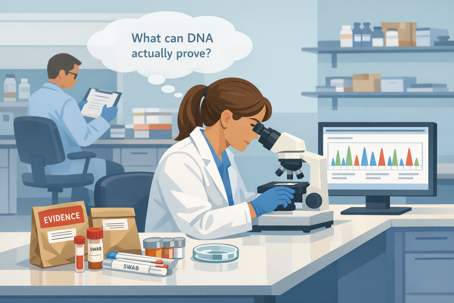
DNA evidence is often viewed as the most powerful type of evidence in a criminal case. In sexual assault prosecutions in South Carolina, DNA testing can play an important role. However, understanding what DNA evidence can and cannot prove is critical.
In many cases, the presence of DNA is not the end of the analysis. It is only the beginning.
What Is DNA?
DNA, or deoxyribonucleic acid, is the genetic material found in nearly every cell of the human body. It carries the biological instructions that make each person unique.
DNA can be found in a variety of biological materials, including blood, semen, saliva, and skin cells. In fact, simple contact, such as touching an object or another person can leave behind what is often referred to as “touch DNA.”
Modern forensic testing focuses on specific regions of DNA that vary between individuals. By analyzing these regions, scientists can develop a DNA profile that can be compared to a known individual.
While DNA profiles are highly discriminating, they are not a complete picture of what occurred in a given situation.
Direct vs. Indirect DNA Transfer
One of the most important and often misunderstood concepts in forensic DNA analysis is the difference between direct and indirect transfer.
Direct transfer occurs when DNA is deposited through physical contact. For example, if a person touches another individual, their skin cells may be transferred directly.
Indirect transfer, sometimes called secondary transfer, occurs when DNA is passed through an intermediary. For example, a person could shake someone’s hand and then that person later touches a third individual, potentially transferring DNA without the original person ever having direct contact.
Scientific research has shown that indirect transfer is possible under real-world conditions. This means that the presence of a person’s DNA on an item or individual does not necessarily prove that they were ever physically present at the location where the DNA was found.
Importantly, DNA analysts are often unable to determine whether DNA was deposited through direct or indirect transfer. The testing process identifies whose DNA may be present, but it does not reveal how it got there.
The Role of SLED in DNA Testing
In South Carolina, forensic testing in criminal cases is typically conducted by the South Carolina Law Enforcement Division (SLED). SLED maintains forensic laboratories where trained scientists analyze biological evidence collected during an investigation.
In sexual assault cases, this analysis is often divided into two separate areas of expertise: serology and DNA analysis.
Serology: Identifying Biological Evidence
The first step in many cases is performed by a forensic serologist. A serologist’s role is to determine whether biological material is present and, if so, what type.
In a sexual assault investigation, this commonly involves testing for the presence of semen.
Semen is typically identified through a chemical screening test designed to detect substances commonly found in seminal fluid. If that test indicates a possible positive result, further examination may be conducted.
To confirm the presence of sperm cells, a forensic analyst will use a microscope. The identification of sperm cells can be significant, but it is important to understand that not all semen samples contain sperm, and the absence of sperm does not necessarily mean that no sexual activity occurred.
DNA Analysis: Comparing Genetic Material
Once biological material is identified, a DNA analyst may attempt to develop a DNA profile from the sample.
This process involves extracting genetic material and comparing it to a known individual, such as a suspect. The goal is to determine whether the DNA profile from the evidence is consistent with the known sample.
If a match is reported, it is typically expressed in statistical terms. For example, an analyst may testify about how rare it would be to randomly select another individual from the population with the same DNA profile.
In some cases, samples may contain DNA from multiple contributors. These “mixtures” can be complex and require interpretation, which introduces an additional layer of subjectivity into the analysis.
Expert Testimony in Court
Both serologists and DNA analysts are generally presented as expert witnesses by the prosecution.
Before offering opinion testimony, these witnesses must be qualified as experts by the court. Once qualified, they are permitted to explain their testing methods, results, and conclusions to the jury.
This testimony can sound highly technical and persuasive. However, it remains subject to cross-examination, and the defense has the right to challenge both the methods used and the conclusions reached.
The defense also has a right to retain their own DNA expert, to assist in reviewing the evidence pre-trial as well as in-court testimony.
What DNA Evidence Can—and Cannot—Prove
DNA evidence can be extremely useful in identifying whether a particular individual may be the source of biological material found in a case.
However, DNA evidence alone does not explain how or when that material was deposited.
- It does not establish consent.
- It does not establish force.
- It does not establish intent.
It also cannot reliably distinguish between direct contact and indirect transfer.
In other words, DNA may help answer the question of who, but it does not answer the question of what happened.
Why This Matters
Because DNA evidence carries such weight with juries, it is important that it be carefully examined in every case.
Issues can arise in how evidence is collected, stored, tested, or interpreted. Even when the science is sound, the conclusions drawn from that science may be overstated or misunderstood.
Understanding the limits of DNA evidence is just as important as understanding its strengths.
Talk to a South Carolina Criminal Defense Lawyer
South Carolina criminal defense attorney James R. Snell, Jr., has experience in representing clients in sexual assault and other case-types, including criminal sexual conduct, criminal sexual conduct with a minor, incest, or assault. His office offers free initial consultations. Your discussions with the attorney in that consultation are confidential. You will have the opportunity to explain the exact circumstances of your case to the attorney, and ask any question you may have about the law or applicable court or defense procedures available to you.
Call (803) 359-3301 today to schedule a consultation. Same-day appointments are often available.
Every case is unique. Prior results do not guarantee or indicate a similar outcome.