
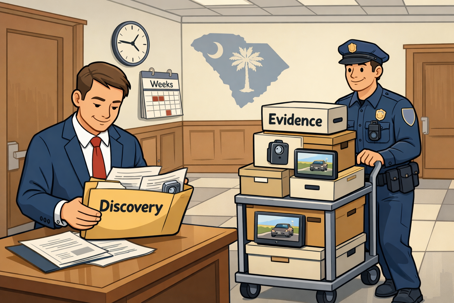
If you’ve been arrested, you need to know how long it will take to receive the evidence in your case. This article discusses this in the context of post-arrest, meaning in situations where you have been arrested and are facing a specific criminal charge in a South Carolina criminal court.
The process by which an attorney obtains a copy of the evidence from the government is called discovery. However, this is only one way of obtaining information or evidence in your case. In addition to obtaining materials from the government, you also have a right to conduct a defense-oriented investigation including interviewing witnesses or issuing subpoenas.
Summary:
- Production of case information from the government is controlled through a process called discovery
- There is no specific time-frame for the South Carolina criminal discovery process, however 4-6 weeks is typical
- Discovery materials are not the same as evidence, and items produced may or may not be relevant to the case or admissible in court
- If discovery is not timely produced the court may provide the government with a specific deadline, or otherwise may suppress evidence or, in rare situations, even dismiss the case
Request and Review of Discovery
In most cases, the first step undertaken by a defense attorney is the preparation and filing of discovery motions with the court. Typically, in South Carolina criminal cases this would include motions pursuant to Rule 5 of the South Carolina Rules of Criminal Procedure, as well as Brady v. Maryland, a United States Supreme Court Case requiring the government to turn over any favorable evidence to the defense. This procedure is available for all levels of criminal cases in South Carolina, including cases pending in city courts, county magistrate’s courts, and General Sessions court.
These motions can be filed and submitted quickly, typically at the Law Office of James R. Snell, Jr., LLC, we submit these initial motions immediately upon being retained (sometimes within the first few hours). Next, they are provided to the prosecutor for this case. In most city and magistrate court cases the prosecutor will be the police officer responsible for the arrest. In General Sessions court the prosecutor will work for either the Solicitor’s or Attorney General’s office.
There is no automatic time-period that the government must turn over materials. In most situations materials are provided within approximately 4-6 weeks. Complex cases may take longer. Cases involving multiple law enforcement agencies may also take longer (for example, a DUI with a traffic stop by a police department but arrest by the Highway Patrol). Also, for cases in General Sessions court, there may be an additional delay since the case file needs to be transmitted from law enforcement to the prosecutor’s office at the onset of the case. This can often take up to thirty days by itself. Unfortunately, there may not be much, if anything, the defense can do to speed up this process other than make sure initial motions are submitted and alerting the prosecutor to the fact that the materials are being requested.
If discovery materials are not timely produced, a motion to compel discovery can be filed with the court or the matter of outstanding discovery can be raised at a pre-trial or status conference. This can result in the court providing a strict deadline on the prosecutor to turn over available materials. If those materials are not produced, the court may elect to either suppress portions of the state’s case that would relate to the absent materials or in rare situations dismiss the entire case.
Post Arrest – Use of Subpoenas and Defense Investigators
Production of evidence materials through discovery does rely on cooperation or at least compliance by the government. One limitation is that discovery only will produce materials in the possession of, or at least known to, the government.
Beyond the discovery process, defendants also have a right to conduct a defense-oriented investigation of their own. This can help identify helpful witnesses, documents, or other evidence not known to or in the possession of the government.
For example, a common strategy is to incorporate a licensed investigator to work on behalf of the defense in a serious criminal case. This investigator can assist the defense by seeking to identify, locate, and interview potential witnesses. They can also utilize skip tracing and other databases that the investigator may subscribe to.
Beyond use of an investigator, the defense may also issue subpoenas to third-parties to uncover documents, video recordings, or other materials that may be helpful. If those records are held by the Department of Social Services (DSS) or otherwise pertain directly to the victim in the case a court order is normally required prior to the issuance of the subpoena.
Why does it take so long to receive discovery?
It is easy to think that nothing is happening early in a case. Production of discovery materials does take time, and some delay is perfectly normal. In most misdemeanor cases prosecuted by a police officer, that specific officer is responsible for copying and forwarding materials. This means the same officer who is responsible for driving a police car and responding to 911 calls is also tasked with copying paperwork and videos for forwarding to defense attorneys. For cases prosecuted by a prosecutor they cannot forward materials they don’t yet have, and oftentimes it is several weeks to a month or more before law enforcement provides their case file to the prosecutor’s office.
Over the last several years the amount of discovery materials produced in a given case has increased. Many cases now involve body cam footage from responding police officers. DUI cases and others involving traffic stops also involve dash cam footage. This has added to the average length of time discovery takes to be produced.
It is also not uncommon for discovery materials to be received in stages. There can be initial discovery, which is produced first, and then supplemental discovery which is received later. This can be because it takes longer for the prosecutor to process discovery at the onset of a case, and they send over what they can at first. Another reason for supplemental discovery is when new materials are collected by law enforcement or the prosecutor while the case is pending.
What do you do with discovery?
Once the defense obtains discovery from the government, as well as any other materials or witness statements obtained through its own investigation, these can be reviewed to learn more about the case. It’s important to consider what the evidence is, what it isn’t, and what the defenses to a given charge may be.
Even though discovery materials are frequently referred to as evidence, there is an important distinction to be made. Items produced in discovery or otherwise discovered by a defense investigation are not automatically admissible in court. Further, many items which may be produced may have no relevance to a given case or otherwise not be admissible at all. For example, standard pre-trial discovery will require production of police incident reports, however in most situations those reports will never be introduced in trial or actually reviewed by the court in determining whether a defendant is guilty of the accused crime. Those reports however can be helpful in preparing to question a police officer or other witness during their in-court testimony.
We typically provide discovery materials immediately upon receipt to our client. Our lawyers are able to discuss discovery materials with our clients quickly, but it does take time to make sure that discovery is carefully reviewed by an attorney, including watching all video recordings, before a full assessment is complete.
Does the defendant receive a copy of discovery?
Yes. In some specific circumstances providing actual copies of some materials may be limited by court order or law (such as cases involving illegal photographs of minors), or situations where the defendant is incarcerated (and cannot possess or view digital materials). Otherwise discovery materials can be provided directly to the defendant. We recommend individuals with pending criminal charges carefully review the discovery materials and discuss the contents with their attorney.
How long after arrest does my lawyer request discovery?
The amount of time it takes to request discovery can vary from lawyer to lawyer. At the Law Office of James R. Snell, Jr., LLC, discovery requests are submitted immediately upon being retained, often the same day.
What types of materials are actually included in the discovery?
The exact contents of discovery will vary from case to case, but often includes the following items:
- Police incident reports
- Investigative summaries
- Copies of arrest warrants
- Witness statements
- Police officer body-cam footage
- In-car dash-cameras
- 911 Audio
- Other materials obtained by law enforcement during the investigation
- DMV Driving History Report (listing of prior traffic tickets and license suspensions)
- Prior criminal history report (your RAP sheet)
- DUI discovery can also include a copy of the video recording from the jail breath site, scoring information for any field sobriety tests, and records applicable to any blood or urine testing.
- In drug cases discovery can also include the laboratory findings from any analysis. This is normally received long after the arrest, often several months or more.
Contact the Law Office of James R. Snell, Jr., LLC Today
If you’ve been accused or are charged with a crime in South Carolina we can help. Whether it’s DUI, domestic violence, drug charges, or any other serious offense we can help. We offer free consultations, and same-day appointments are typically available. Not only can our attorneys represent you in court, we also utilize discovery and other investigative techniques to help prepare your case for court. Call us today at (803) 359-3301.
All cases are unique, and prior results do not guarantee similar outcomes.