
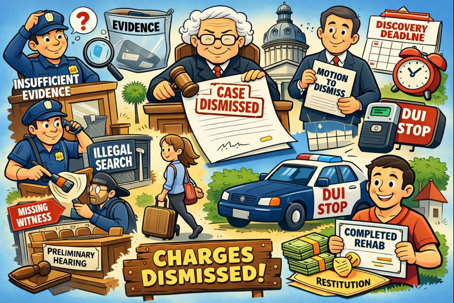
Being investigated for a crime or arrested in Columbia or Lexington, South Carolina can feel overwhelming and frightening. Many people assume that once criminal charges are filed, the case will inevitably go to trial and end in a conviction. In reality, criminal charges are dismissed every day in Richland County and Lexington County for a variety of reasons. In our practice, we routinely represent clients who avoid charges entirely during an investigation, as well as clients whose cases are dismissed after arrest but before trial. This occurs in cases ranging from white collar allegations to sexual abuse accusations, drug offenses, DUI charges, and even serious violent felony cases.
Understanding why criminal charges may be dismissed in Columbia or Lexington can help explain how the South Carolina criminal justice system actually works.
Dismissal Decisions Are Usually Made by the Prosecutor
In most situations, criminal charges are dismissed after arrest only when the prosecutor voluntarily decides to do so. South Carolina law does not generally allow a defendant to file a pretrial motion asking a judge to dismiss a case simply because the evidence appears weak. As a result, dismissal typically depends on the prosecutor’s independent review of the case rather than a judicial ruling.
The identity of the prosecutor depends on the court handling the case. In magistrate court and municipal court cases in Lexington or Columbia, the prosecutor is often the law enforcement officer who made the arrest. In General Sessions cases in Richland County or Lexington County, prosecution is handled by an attorney employed by the Solicitor’s Office or, in some cases, the South Carolina Attorney General’s Office. Each prosecutor has discretion to evaluate the evidence, legal issues, witness availability, and whether moving forward is appropriate.
South Carolina provides only a limited opportunity to challenge the sufficiency of evidence before trial through a preliminary hearing. Even then, that hearing has a narrow scope. A case can still proceed even if concerns are raised at a preliminary hearing, as long as the charge is later approved by a grand jury. Because of this structure, dismissals most often occur when prosecutors determine that continuing the case is not justified.
Insufficient Evidence
One of the most common reasons criminal charges are dismissed in Columbia and Lexington is insufficient evidence. The government has the burden of proving every element of a criminal charge beyond a reasonable doubt. Sometimes, after reviewing the evidence more closely, prosecutors determine that this burden cannot be met.
Insufficient evidence can arise in many ways. Physical evidence may be missing, unreliable, or improperly collected. Witness statements may be inconsistent or lack credibility. Surveillance footage, forensic testing, or digital evidence may fail to support the allegations. In some cases, law enforcement may initially believe there is enough evidence to justify an arrest, but further review reveals significant weaknesses that make continued prosecution inappropriate.
When the evidence does not support a reasonable likelihood of conviction in a Richland County or Lexington County court, dismissal becomes the appropriate outcome.
Legal Defenses and Constitutional Violations
Criminal charges may also be dismissed when legal defenses expose violations of a defendant’s constitutional rights. Law enforcement agencies in Columbia, Lexington, and throughout South Carolina are required to follow strict rules when conducting investigations, searches, traffic stops, and arrests. When those rules are violated, key evidence may be excluded, which can significantly weaken or destroy the prosecution’s case.
This commonly arises in drug possession cases involving illegal searches or seizures. If law enforcement lacked a valid warrant or a recognized legal exception, the evidence may be suppressed. In DUI cases, an improper traffic stop in Columbia or Lexington can result in all evidence obtained afterward being excluded from court.
Dismissals can also occur when the prosecution fails to comply with court-ordered deadlines. In South Carolina, there is no automatic deadline requiring discovery to be turned over to the defense. However, a judge may impose specific deadlines in an individual case. When the government fails to comply with those orders, consequences can include sanctions or dismissal of charges.
Witness Unavailability
Many criminal cases in Columbia and Lexington rely heavily on witness testimony. If the prosecution cannot identify, locate, or present a necessary witness in court, the case may not be able to proceed. Witness unavailability can occur for many reasons. A civilian witness may move away, refuse to cooperate, or fail to appear despite requests from the prosecutor. In other cases, a law enforcement officer involved in the investigation may leave the department or otherwise become unavailable to testify.
Without essential witnesses, the prosecution may be unable to meet its burden of proof, making dismissal the only realistic option.
Strong Mitigation and Corrective Action
In less serious cases, prosecutors in Lexington County and Richland County sometimes dismiss charges when a defendant takes meaningful corrective action. This is often referred to as mitigation. Examples include paying restitution in financial or property-related cases, restoring a suspended driver’s license in a driving under suspension case, or completing drug or alcohol treatment when substance use played a role in the alleged offense.
These types of resolutions typically occur before trial and are more common in misdemeanor and lower-level criminal cases. Demonstrating responsibility and compliance can persuade prosecutors that dismissal is a fair and appropriate outcome.
What a Criminal Defense Lawyer Can Do
Although no criminal defense lawyer in Columbia or Lexington can ever promise or guarantee a dismissal in a criminal case, there are strategies that can improve the likelihood of that result. Early legal intervention during a criminal investigation can sometimes prevent charges from being filed at all by identifying legal problems, evidentiary weaknesses, or missing proof before a case formally begins. After an arrest, there are additional steps that can influence the outcome, including requesting a preliminary hearing when available, filing discovery motions, conducting a defense-oriented investigation, and carefully reviewing the evidence to determine what it does or does not actually support. Preparing the case for a fully contested trial, including having the ability and willingness to try the case in a Columbia or Lexington courtroom, can also impact how prosecutors evaluate whether continuing the prosecution is appropriate.
Every Case Is Unique
Criminal charges may be dismissed for many different reasons, and no two cases are exactly alike. Outcomes depend on the specific facts, evidence, legal issues, and people involved in each case. All cases are unique, and prior results obtained by the attorney in one matter does not indicate similar results can be obtained for other clients in other matters.
If you are under investigation or facing criminal charges in Columbia or Lexington, South Carolina, speaking with an attorney early can be critical. To discuss your situation and learn what options may be available, call (803) 359-3301. Same day appointments are typically available.