
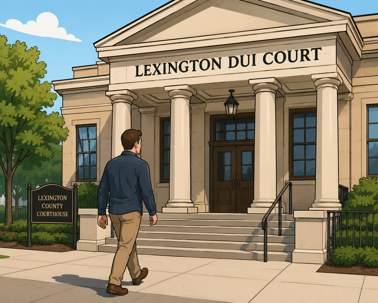
If you’ve been charged with a DUI in Lexington, SC, you will be wondering what are the possible outcomes for your case. DUI defense attorney James R. Snell, Jr, has over 20+ years’ experience in representing clients in all Lexington area courts including the Lexington County DUI Court and the Town of Lexington Municipal Court. This information also applies to DUI charges in other areas, including Columbia, SC. In this article he reviews the possible outcomes for your DUI case.
When you have been arrested for DUI, this means you have been accused of DUI by the police. DUI arrests are not initially reported to the DMV (but breath testing results can be), and you do not face any of the penalties unless you are convicted in court. You become convicted of DUI only when you plead guilty, no-contest, or are found guilty after a trial.
Every DUI charge has the same possible range of possible outcomes. It’s impossible to know for certain what the outcome will be in any specific case at the onset. However, it is helpful to know what the possibilities are so you will be prepared to make decisions regarding your case.
What are the possible outcomes for DUI in Lexington?
- Dismissal – This refers to a scenario where the prosecutor (or police officer if in a court where police prosecute their own cases), agrees just to drop the case. This may be because of a significant lack of evidence, significant legal problem with the case, or unavailability of a witness (such as the police officer left employment). While this is possible in any DUI case, it is not the normal or typical outcome. Many area prosecutors and police officers would prefer to see a weak DUI case be found not-guilty at trial than just to agree to dismiss it.
- Negotiated outcome – This includes resolutions where a DUI is reduced to reckless driving or another offense (speeding, equipment violations, failure to maintain lane, etc.), or an agreement to lower the sentence (such as avoiding jail time). When a DUI is reduced to another offense it will result in the DUI being dismissed and being expunged from your record.
- Trial Verdict – If your case is taken to trial, the court will return a verdict of either not-guilty or guilty. A not-guilty means that your DUI is dismissed, you face no fines or other penalties, and the record of the arrest will be expunged from your record. A guilty verdict means that you will be convicted, have the DUI placed on your record forever, be sentenced by the judge to either a fine or jail time, and the DMV will also automatically assess penalties against your driver’s license.
While every DUI case will be resolved in one of these three ways, determining which outcome is likely in your case or would be in your best interest to pursue requires careful consideration. This includes obtaining and reviewing pre-trial discovery materials including police reports, camera footage, field sobriety testing results, breath test procedures, and the other evidence and circumstances of the arrest.
While no lawyer can guarantee or promise any specific outcome in a DUI or other legal case, the rule at the Law Office of James R. Snell, Jr., LLC, is to seek to fully contest our client’s DUI arrest, including a trial, if necessary, unless the prosecutor agrees to dismiss or reduce the charge to our client’s satisfaction.
There are several strategies we employee to help maximize the chances of a favorable result for our client’s DUI charge. This begins by having a solid understanding of South Carolina DUI law, and available court procedures that can aid the defense. Additionally, attorney James Snell has completed training in police DUI investigative techniques, and is qualified as an instructor in the official field sobriety testing curriculum used by police departments in South Carolina, and is the author of South Carolina DUI Defense: The Law and Practice. He has also completed training in the operation and possible challenges to police breath testing equipment, and numerous seminars conducted by the National College of DUI Defense related to other chemical testing applicable to urine and blood samples.
Here is the general timeline applicable to most DUI cases in Lexington, SC
- We begin by offering a free initial consultation. You can make an appointment by calling (803) 359-3301. Initial appointments are conducted in our downtown Lexington, SC office. During this appointment you will have a chance to explain the exact circumstances of your arrest to the attorney, and ask any questions that you may have. The attorney will review with you the steps applicable to your specific case. Same day appointments are usually available.
- After being retained for your case, we will immediately begin by making the initial court filings. This includes paperwork with the court notifying them we are representing you and are contesting your arrest. We also file paperwork with the court that is sent to the prosecutor’s office requesting copies of the materials collected by law enforcement regarding your arrest. This is called discovery, and usually includes police officer body camera footage, in-car dash camera footage, the police officer’s report, scoring information for any field sobriety tests, and documents applicable to any blood, breath or urine testing.
- If an implied consent suspension applies, we will file the paperwork with the Office of Motor Vehicle Hearings to contest that suspension as well. This can help restore your right to drive if your license was taken by the officer quickly, usually within two business days. Hearings related to implied consent suspensions are held separately from the DUI charge, and are typically scheduled 2-3 months after arrest.
- Within a few weeks to a few months, the prosecution or police department will produce the discovery materials requested by our office. This includes video recordings and documents relevant to your DUI case. Our attorneys will review these materials, looking for possible legal challenges to the DUI as well as for the evidence both for or against the allegation of impaired driving. We also provide a copy to our client, and discuss our findings and impressions with them. This is critical information because it helps you decide if you would prefer to fully contest your case in trial, or request a negotiated resolution to a reduced level charge or sentence.
- Within a few months (or more depending on the exact court involved), the court will schedule a pre-trial conference. This is an opportunity for us to discuss the case with the prosecutor, follow up on any missing discovery materials, and to enter into any negotiations requested by our client. Some DUI cases are resolved at or before the first pre-trial, some cases require several pre-trial dates.
- When a DUI case cannot be dismissed or reduced to our client’s satisfaction through negotiation with the prosecutor, they are scheduled for trial at a future date by the court. We are available to take any DUI case in Lexington to trial, and never require our clients to accept any plea offer. While no lawyer can ever promise or guarantee any specific outcome to a DUI case, we will not hesitate to fight your case in court if it isn’t resolved otherwise to your satisfaction.
During the time your case is pending you will have the ability to reach out to us for any questions or concerns you may have about your case. We maintain regular office hours, and our attorneys are supported by a staff of trained staff.
Implied Consent Violations
If you refused a breath, blood or urine test at the time of arrest, or provided a breath sample of 0.15% or higher, this will trigger an implied consent suspension. This is a separate charge from the DUI, and will be immediately be reported to the DMV. You know if this applies to your DUI case if you received a Notice of Suspension Form when you were at the jail, or the police officer took your driver’s license.
If this applies to you, we can help you challenge this suspension at the Office of Motor Vehicle Hearings, and can file the necessary paperwork to restore your driving privileges immediately upon being retained. This type of suspension applies even if you haven’t been to court yet on the DUI, and even if your DUI was later dismissed.
Approximately 60% of DUI arrests will also have a corresponding implied consent violation for either refusing a breath, blood or urine test, or providing a breath sample of 0.15% or higher. If this does, we recommend you contact our office immediately so that we can take the necessary steps to help you challenge this suspension and restore your driving privileges.
What courts in Lexington, South Carolina, hear DUI cases?
There are numerous individual courts in and around Lexington, South Carolina, that hear DUI cases. The following courts have jurisdiction to hear DUI 1st offense charges:
- Lexington County DUI Court
- Town of Lexington Municipal Court
- Batesburg-Leesville Municipal Court
- Irmo Municipal Court
- West Columbia Municipal Court
- Cayce Municipal Court
- Pelion Municipal Court
- Gaston Municipal Court
- Pine Ridge Municipal Court
- South Congaree Municipal Court
- Springdale Municipal Court
- Chapin Municipal Court
DUI 2nd+ offenses are heard exclusively in the Lexington County Court of General Sessions. While the underlying law is the same for a DUI 2nd or 3rd offense compared to a 1st offense, the potential penalties are significantly higher.
Frequently Asked Questions about DUI Charges in Lexington, SC
Am I at risk of getting sentenced to jail time for a first offense DUI?
South Carolina law provides a possible maximum jail sentence of 30-90 days for all 1st offense DUI cases. This sentence would be imposed by the court only when someone is convicted. You are not convicted unless you plead guilty, plead no-contest, or are found guilty after a trial.
The best way to avoid jail time for a DUI charge is to either be not-convicted, or have a specific outcome with the prosecutor negotiated prior to going in front of a judge. DUI 1st cases involving certain circumstances are, based on the experience and observations of our office, more likely for the court to consider imposing jail. Those circumstances include:
- Involvement in a motor vehicle accident
- Accusation of excessive speeding
- Accusation of dangerous driving such as running stop lights or stop signs
- Having a minor child as a passenger in the motor vehicle
- Prior reckless driving convictions
- Prior DUI convictions (priors over 10 years old will not automatically enhance a DUI)
- Higher blood alcohol test results
- Rude or combative behavior directed towards the police officer
Regardless of whether or not additional jail time is imposed, everyone convicted of DUI 1st will face significant penalties including a lifetime criminal record, a suspension of their driver’s license, a requirement to complete the ADSAP program, obtain SR-22 insurance, and a requirement to install an ignition interlock device.
I’ve never been charged with DUI before. Does this help my case?
Not having a prior DUI record is certainly helpful. It means your current case would be a misdemeanor 1st offense, and not a more serious level. Having a clean record can also make it more likely that a police officer or prosecutor may negotiate more favorably. It will also help minimize the sentence that a judge might impose if you were convicted.
Not having a prior DUI however does not mean that your case will automatically be dismissed or thrown out. Because the Lexington County DUI Court and area municipal courts only have jurisdiction over 1st offense DUI’s, every case they deal with is a 1st offense and as a result, that fact alone does not automatically carry that much significance. This is because every DUI in the court or that the prosecutor is handling will also be a 1st offense.
Can I drive after a DUI arrest?
Being arrested for DUI does not, by itself, suspend your driver’s license. A conviction will suspend your license, but the initial arrest does not and is in fact not even reported to the DMV.
If your arrest though is accompanied by an implied consent violation then your license would be suspended automatically. You receive an implied consent violation for refusing a breath, blood or urine test, or providing a sample registering 0.15% or higher BAC. You will also know if this applies to you if you received a Notice of Suspension Form from the police officer at the time of arrest.
If you are facing an implied consent violation there are procedures we take to quickly restore your driving privileges. This involves challenging the implied consent suspension through the Office of Motor Vehicle Hearings. We can file the necessary paperwork to start this process for your immediately upon being retained, and this typically will restore your driving privileges within approximately 2 business days.(the timeline to restore driving privileges is dependent on you having a valid driver's license at the time of your DUI arrest).
Do I need a lawyer for a Lexington, SC DUI charge?
We believe that everyone facing a DUI charge needs a lawyer. You should consult with an attorney prior to your initial court date, and we recommend you do so as soon as possible after your arrest. The Law Office of James R. Snell, Jr., LLC, offers free initial consultations, and frequently same-day appointments are available. To schedule your appointment call us at (803) 359-3301.
While everyone has the right to represent themselves, hiring a qualified DUI defense attorney will help increase the likelihood of success in your case. Many defenses to DUI are not known until after discovery materials are produced by the government, and then they are able to be reviewed. DUI is also a complex area of the law, and there are numerous South Carolina Supreme Court and Court of Appeals decisions over the past decades that can may create opportunities to challenge your case.
Hiring a lawyer will also give you access to other defense strategies and court procedures that can help increase the likelihood of success in your case. If you appear in court without an attorney no one there, including the judge or prosecutor, is allowed to give you legal advice or make recommendations to you on how to resolve your case.
What happens if the police officer does not appear in court?
Do not expect to have your DUI dismissed because a police officer does not show up in court. While DUI cases are sometimes dismissed if the officer becomes permanently unavailable (for example they leave law enforcement or are arrested themselves), in almost every situation a case will be simply be continued if a police officer is not available for a specific court date.
Police officers are not expected to appear for initial court dates at the Lexington County DUI Court. If you appear at the initial court date, and you decline to plead guilty, the court will be continued to schedule the officer to actually be there to testify against you. Police officers are also not required to be at pre-trial dates, or anything short of an actual scheduled trial.
In municipal courts, the officer and the judge are both employed by the same city or town. If the officer calls in sick, or is otherwise unavailable for any reason, expect their cases to be automatically continued by the court, even if it’s at the last minute.
If you have an implied consent case in the Office of Motor Vehicle Hearings (OMVH), and the officer does not show appear, this usually will result in that suspension being dismissed. This does not affect the status of the DUI pending in court however.
Can I refuse field sobriety tests?
South Carolina drivers are not required to participate in field sobriety tests. South Carolina law even goes as far as to say that refusal to take tests is specifically not against the law. We have seen many examples of police officers arresting someone immediately after declining field sobriety testing.
Field sobriety tests were created to give law enforcement the appearance of credible evidence to present in DUI cases. Attorney James R. Snell, Jr., has been qualified as a field sobriety testing instructor (having completed and passed a NHTSA DWI Detection and Field Sobriety Testing instructor course and examination). When tests are refused, this limits the evidence that a prosecutor has to use against you. If tests were attempted, the defense usually focuses on what those tests actually can prove, whether they were properly administered, and whether they were properly scored by the police officer.
How long does a DUI case take in Lexington, SC?
The timeline for a specific DUI case depends on several factors. Most importantly is going to be the specific court the case is scheduled in. There can be a very wide discrepancy in how long a case takes to be scheduled depending on exactly which court it is in. This is because the municipal courts, which hear DUI cases made by city and town officers, operate completely independently. Some move contested DUI cases in a few months, others in a few years.
Cases that are going to result in a plea agreement, such as to a reduced charge like reckless driving, are usually resolved faster than cases that are going to go to trial.
The fastest way to resolve a DUI case is to simply appear at the first court date and plead guilty. Any steps taken to investigate or challenge a DUI case will add time onto the process.
Can a DUI be dismissed in Lexington, SC?
Yes. DUI charges are sometimes dismissed because of lack of evidence, legal defenses, unavailable witnesses, or defense challenges. Most of the time when a DUI is dismissed it is because the prosecutor or police officer voluntarily decides to just drop the case. While this is not the usual outcome for a DUI case, it is sometimes possible. Any DUI that is not dismissed can still be taken to trial to try to obtain a not-guilty verdict. A not-guilty verdict will also have the same effect as a dismissal.
How important is the results of the breath test?
Breath test results can be important evidence in a DUI case. But they don’t automatically determine if someone is guilty or not-guilty. There is no official “legal limit” in South Carolina DUI cases.
The definition of DUI in South Carolina is driving while materially and appreciably impaired. This is a subjective standard, meaning police have to guess or simply have an opinion as to who they are going to charge.
South Carolina law provides an inference as to impairment depending on the blood alcohol level from a breath or blood test, but that inference does not automatically make someone guilty or not-guilty. This is because DUI charges can be based on alcohol, drugs or any combination of the two. So even without any alcohol a DUI charge can still be made if police believe that someone was under the influence of drugs (even prescription medication). Legally, someone could be guilty or not-guilty of DUI regardless of the blood alcohol level from a breath or blood test (alcohol is not looked for in police urine tests).
This means that you are not automatically guilty if you blew 0.08% or higher. Conversely, you are not automatically not-guilty for blowing 0.7% or less.
In addition, the alcohol level shown by a breath or blood test also controls the penalty level that the court can impose if someone is convicted of DUI. This means that the possible fine or jail time increases based on those results. There are three levels of DUI 0.10% and below (also covering refusals), 0.11-0.15%, and 0.16% and higher.
How soon can I talk to you about my case?
We offer free initial appointments at our office located in downtown Lexington, South Carolina. Same-day appointments are usually available. To schedule your appointment call (803) 359-3301.
During that appointment you will have the chance to meet with an attorney to explain the specifics of your situation, and ask any questions that you may have. We will review with you the exact procedures that can be taken to help challenge your case in court.
Any results the Law Office of James R. Snell, Jr., LLC, may have achieved in past matters do not mean that similar results can be obtained for other clients in other matters. No lawyer can promise or guarantee any specific result for DUI charges.