
If you are facing a DUI charge in Lexington, Columbia or anywhere else in South Carolina, you should know what types of evidence would be presented at your trial. A trial is not the same as a pre-trial conference or appearance date, it’s a formal proceeding where evidence is actually presented and legal arguments made and a court determines if someone will be found guilty or not-guilty.
At a DUI trial the government presents evidence to try to prove guilt. The legal definition of DUI in South Carolina is driving while materially and appreciably impaired. The evidence that the government will introduce will try to prove that beyond a reasonable doubt.
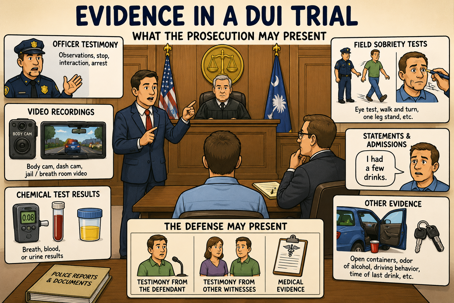
Although every case is different, in most DUI cases the evidence presented by the government will include:
- Testimony from the arresting police officer. The officer who pulled you over, talked with you, administered field sobriety tests, or administered you a breath test, would be expected to take a witness stand during your trial to testify. They would be able to tell the court what observations that they made and the story of your arrest from their perspective.
- Video recordings made by the police. Most DUI cases now include video evidence. This includes body cam footage from the arresting police officer, dash-cam footage from the arresting officer, as well as the video recording made from the breath test room at the jail or police station.
- Breath, blood or urine test results. If you gave a breath, blood or urine sample, then those results can be admitted into court as evidence. This may require testimony from the police officer who administered a breath test, or other laboratory experts if evidence from a urine or blood test is used. If you refused a test that can also be introduced as evidence.
- Field sobriety testing results. If you attempted testing requested roadside by the officer the results will also be offered as evidence by the prosecutor. This includes the test where the police officer looked into your eyes, had you walk a straight line, or balance on one leg. DUI Defense attorney James R. Snell, Jr., has qualified as an instructor in the field sobriety testing curriculum, and we have other staff members who have completed training as well (including another with instructor level training).
In a DUI trial the defense is not required to introduce any evidence. However, if they choose to it can include:
- Testimony from the Defendant. The defendant, personally, has the choice to testify or not testify in court. If the Defendant chooses to testify the prosecutor will then be allowed to cross-examine them.
- Testimony from other witnesses. If there are other witnesses who were with the Defendant prior to the arrest who can offer testimony about whether or not the Defendant appeared under the influence of alcohol or drugs they can testify.
- Video recordings made by any source. If there are videos, including those made by the police, which are favorable to the Defendant they can be played by the Defense.
- Medical evidence. If the Defendant had a medical condition which would be relevant to the DUI case (such as diabetes, or having a leg injury), records or testimony from a medical expert can be presented.
There can be other types of evidence presented depending on the specific allegations by the government, or the specific defense raised. In addition to evidence, the court will also hear argument from the prosecutor as well as the Defense as to why or why not the court should find someone guilty. Argument from the prosecutor or Defense attorney is not evidence, although it can have a significant impact in the decision-making process of the court.
How much proof is required you are guilty of DUI?
In order to be convicted of DUI in South Carolina, the prosecution must prove every element a DUI charge beyond a reasonable doubt. Reasonable doubt is normally defined by the court in a trial as “the type of doubt which would cause a reasonable person to hesitate to act.”
The Defendant is not required to prove their innocence. Instead, the burden is entirely with the government. In a jury trial, the decision must be unanimous with all jurors in agreement in order to convict the Defendant.
Does your DUI case have to go to trial?
The reason people hire the Law Office of James R. Snell, Jr., LLC, regarding their DUI is to pursue opportunities to have the case dismissed or otherwise resolved as favorably as possible.
Many of the DUI cases we are involved in are resolved before trial. This is because the charges are either dismissed outright, or the charges are favorably reduced to a level our client agrees with. While there is no way to promise or guarantee a specific outcome in any DUI case, our attorneys will be prepared and is able to take any case to trial if it is not otherwise dismissed or reduced to our client’s satisfaction.
When a DUI case is dismissed, it will result in the arrest being expunged (erased) your criminal record. Additionally, no DUI will be reported to the DMV or included on your driver’s record. This can have significant benefits for your ability to pass employment or other background screenings.
Many DUI cases are resolved with a reduction to a lesser-offense. This includes having the DUI dismissed, as mentioned above, and a new ticket being written for the lesser-offense. Examples of possible reductions include public disorderly conduct, too fast for conditions, or reckless driving.
What happens when you contact us about your DUI case?
The first step to obtain help for your DUI is to contact our office directly to schedule an appointment. We offer free consultations with an attorney, and same-day appointments are usually available. Appointments ae scheduled in our main downtown Lexington office located at 123 Harmon Street. We accept DUI defense matters in Lexington, Columbia, and throughout South Carolina. Call (803) 359-3301 to schedule your appointment.
During that appointment you will have the chance to meet with an attorney and discuss the specifics of your case. You will have the opportunity to ask any questions that you may have, and the attorney will be able to provide you with a description of the step-by-step process as to how your DUI case can be challenged.
In addition to DUI charges, we also help with implied consent violations (if your license was suspended for the breath test procedure), or other charges brought with the DUI. This can include tickets like open container, or driving under suspension, or more serious charges like leaving the scene of an accident or drug possession.
Once retained we will quickly begin the process to help your case by filing the necessary paperwork with the court, and filing any required paperwork with the Office of Motor Vehicle Hearings to help challenge a license suspension if applicable to your case.
Disclaimer: Every case is unique. The facts and circumstances of each DUI case are different. Prior results obtained by the Law Office of James R. Snell, Jr., LLC, in one matter do not guarantee or indicate similar results can be obtained in any other case.