
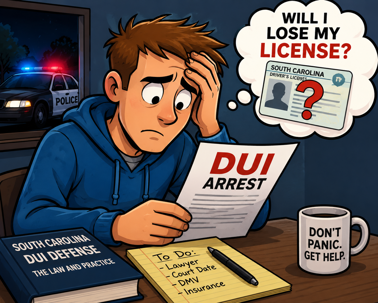
Being arrested for DUI can be overwhelming. One of the first questions many people ask is, "Am I going to lose my driver's license?"
The answer is: maybe, but not necessarily.
Many people are surprised to learn that you do not automatically lose your driver's license simply because you were arrested for DUI in South Carolina. Whether your license is suspended depends on what happens after the arrest and whether an implied consent suspension applies.
Two Ways You Can Lose Your License After a South Carolina DUI
There are generally two ways your driver's license can be suspended after a DUI arrest in South Carolina.
1. A DUI Conviction
The first way is if you are actually convicted of DUI.
A conviction occurs if you:
- Plead guilty to DUI; or
- Are found guilty after a trial.
A DUI arrest by itself is not reported to the South Carolina Department of Motor Vehicles (DMV). However, if you are convicted, the court reports the conviction to the DMV, which then automatically imposes the required administrative penalties.
Depending on the circumstances, those penalties can include:
- Driver's license suspension
- Mandatory SR-22 insurance
- Ignition Interlock Device (often called the "blow and go" device)
These consequences can affect your ability to drive, your insurance costs, and your daily life.
2. An Implied Consent Suspension
The second way you can lose your license is through an implied consent violation.
South Carolina's implied consent law generally applies when a driver:
- Refuses to provide a breath, blood, or urine sample after a lawful DUI arrest; or
- Provides a breath sample showing an alcohol concentration of 0.15% or higher.
Unlike a DUI conviction, an implied consent suspension is typically reported immediately to the DMV.
If applicable, the arresting officer will usually provide you with notice of the suspension shortly after you refuse testing or provide a qualifying breath sample. The suspension generally becomes effective immediately.
Can You Fight an Implied Consent Suspension?
In many cases, yes.
If your driver's license was suspended because you refused a breath test, it is important to act quickly. There are procedures available to challenge the suspension through the South Carolina Office of Motor Vehicle Hearings. Let us know at the time you make an initial appointment that you have received the Notice of Suspension Form.
After being retained, our office can begin that process immediately. In many cases, clients are able to obtain a new driving credential in approximately two business days while the challenge is pending.
Because strict deadlines apply, it is important to seek legal advice as soon as possible after your arrest.
Protecting Your Driving Privileges
Every DUI case is different. Whether your case involves an accident, an alleged high blood alcohol concentration, a breath test refusal, or a second or third offense, protecting your driver's license is often one of the most important concerns.
Our office has experience defending DUI cases arising from a wide variety of circumstances. We understand the importance of protecting not only your driving privileges, but also fighting the criminal charge itself and minimizing the potential consequences. Our DUI defense attorneys help people negotiate favorable reductions in their case or fight to help you avoid a conviction.
James R. Snell, Jr. has more than 20 years of experience defending DUI cases in South Carolina. He is the author of South Carolina DUI Defense: The Law and Practice, has completed training in police DUI investigation techniques, has received training in reviewing and challenging breath test results, and is a member of the National College of DUI Defense.
If you have been arrested for DUI in Lexington, SC, Columbia, or anywhere in the surrounding areas, we offer free consultations, and same-day appointments are typically available.
To schedule your consultation, call the Law Office of James R. Snell, Jr., LLC today at (803) 359-3301.
Disclaimer: This article is provided for general informational purposes only and is not legal advice. Every case is unique. Prior results obtained by the attorney in one matter do not indicate similar results can be obtained for other clients in other matters.